Futuro Nazionale: who counts as Italian, and for how long?
A reading of the first programmatic document of Italy's newest radical right party. Italian quotations verbatim; translations mine.
The programme of Italy's newest radical right party does not only say who should be kept out. It sets out what the nation is made of, how one may enter it, and how one may be removed from it.
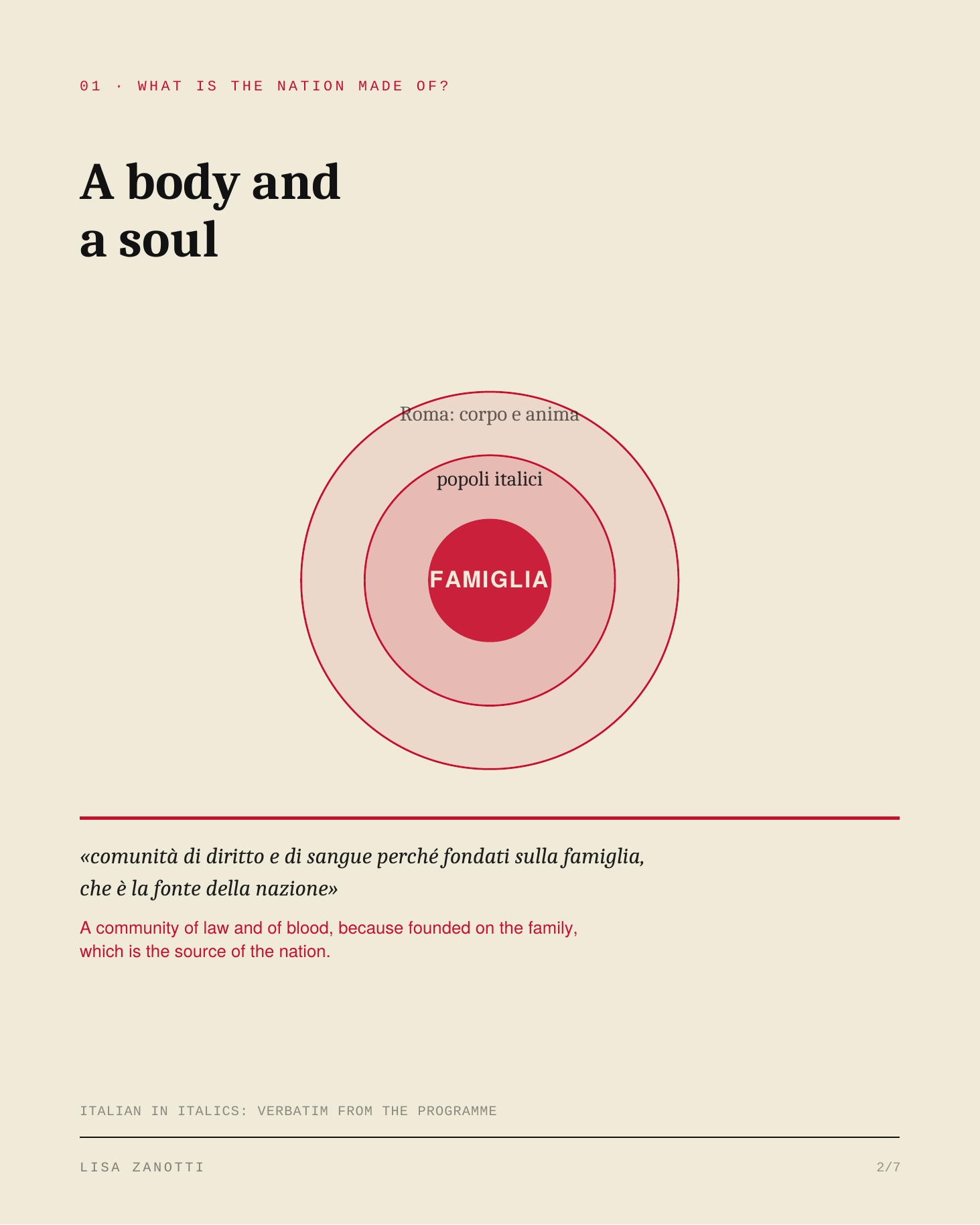
The nation is defined as a body and a soul: Rome as «corpo e anima», the popoli italici, and the family as its source — «comunità di diritto e di sangue perché fondati sulla famiglia, che è la fonte della nazione» (a community of law and of blood, because founded on the family, which is the source of the nation).
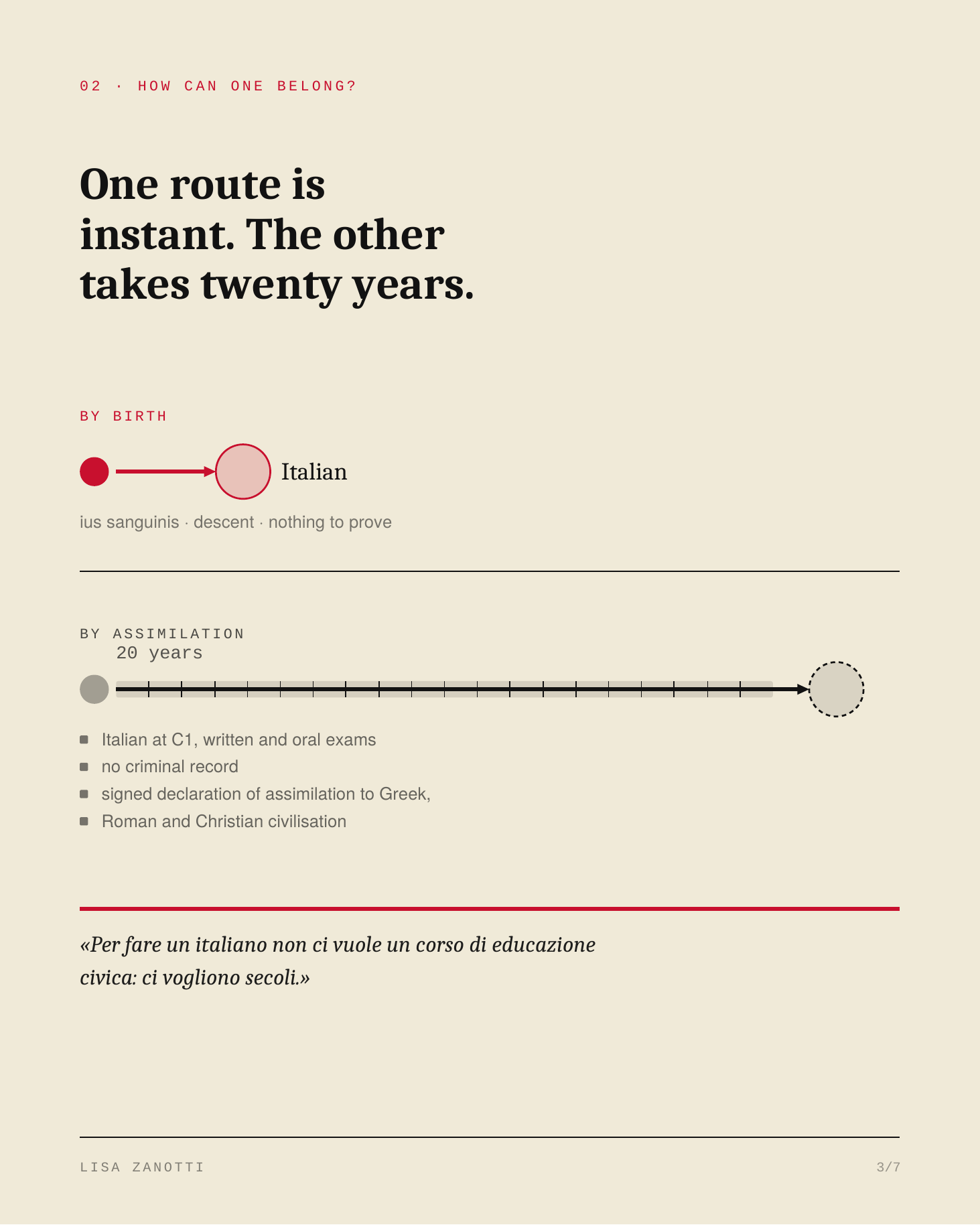
Two routes into membership are set out, and they are not equivalent. One is instant: ius sanguinis, descent, nothing to prove. The other takes twenty years and requires Italian at C1 with written and oral exams, a clean criminal record, and a signed declaration of assimilation to Greek, Roman and Christian civilisation. «Per fare un italiano non ci vuole un corso di educazione civica: ci vogliono secoli.»
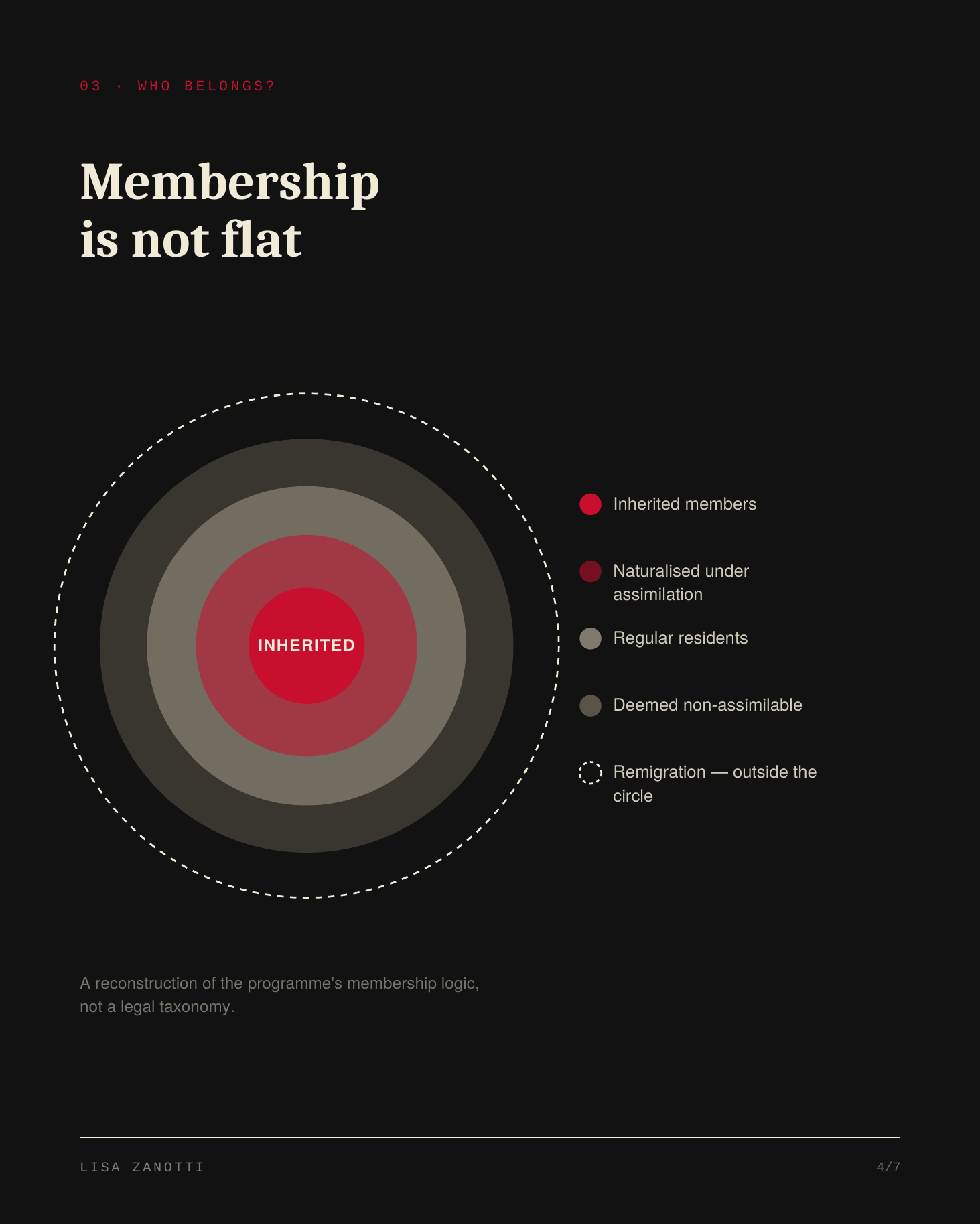
Membership, therefore, is not flat. Inherited members, those naturalised under assimilation, regular residents, those deemed non-assimilable, and those subject to remigration occupy different positions in relation to the national circle.
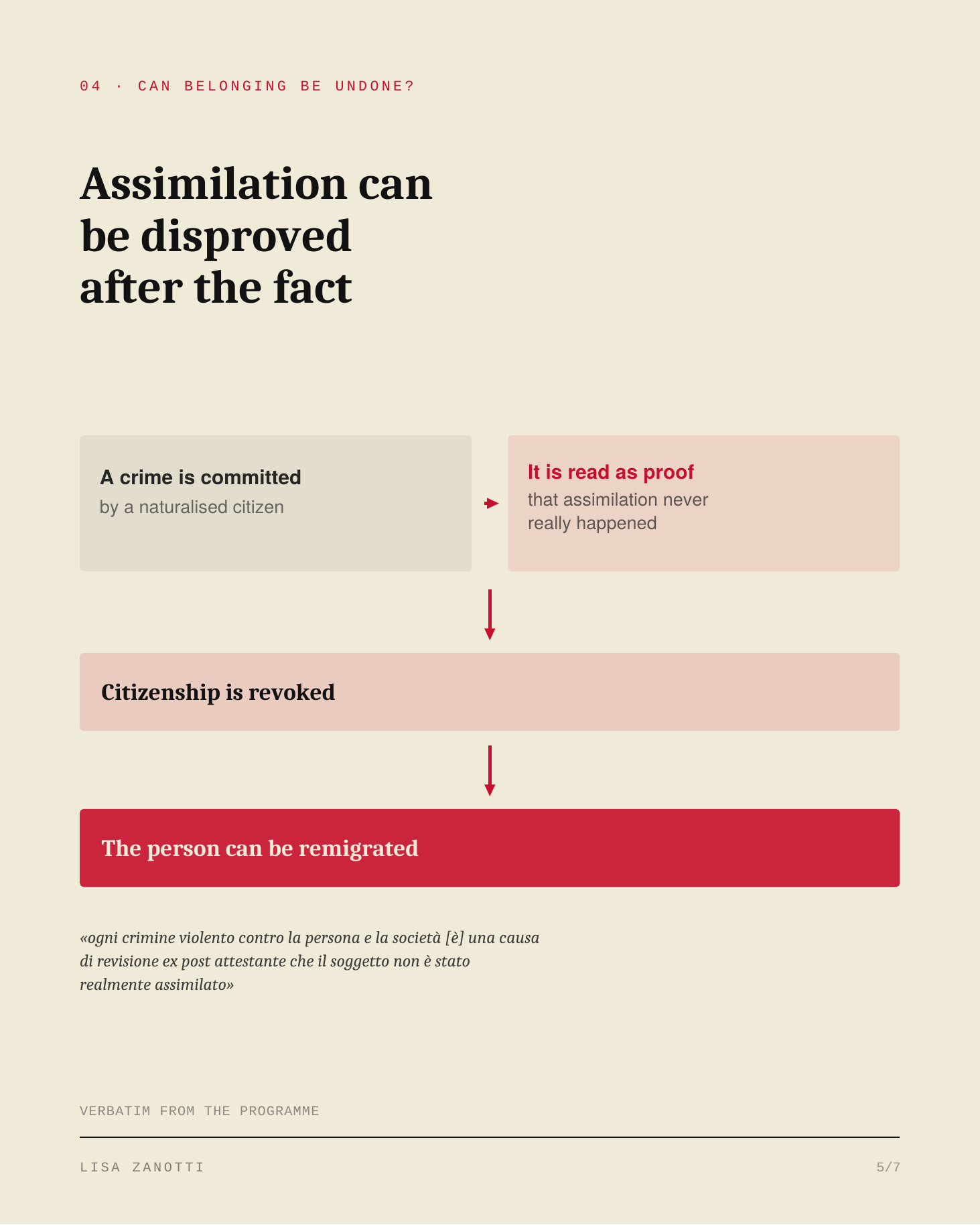
Belonging can also be undone. Assimilation may be disproved after the fact: a violent crime committed by a naturalised citizen is read as evidence that assimilation never really happened — «ogni crimine violento contro la persona e la società [è] una causa di revisione ex post attestante che il soggetto non è stato realmente assimilato» — and can lead to revocation of citizenship and to remigration.
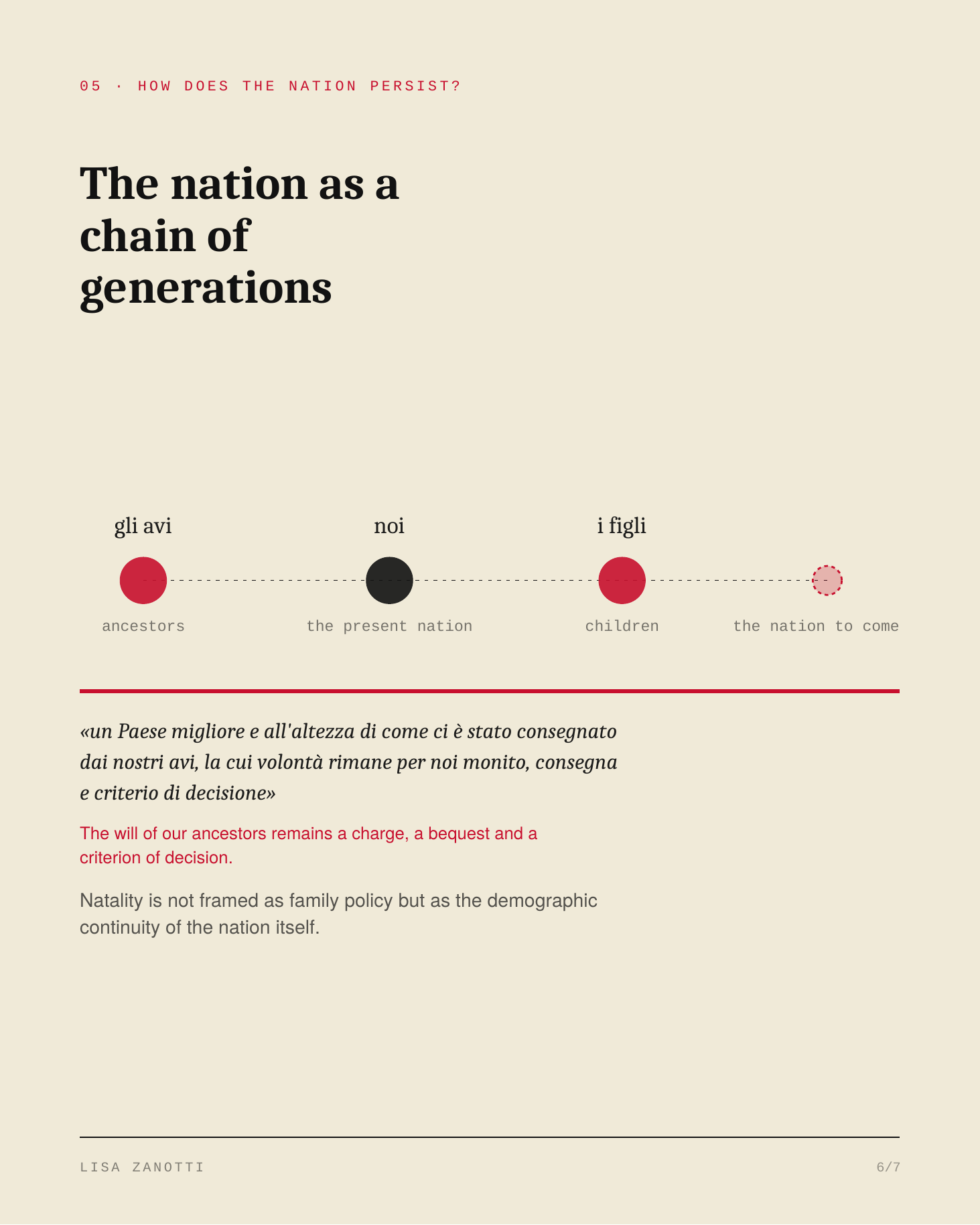
The nation persists as a chain of generations: gli avi, noi, i figli. «Un Paese migliore e all'altezza di come ci è stato consegnato dai nostri avi, la cui volontà rimane per noi monito, consegna e criterio di decisione.» Natality is not framed as family policy but as the demographic continuity of the nation itself.
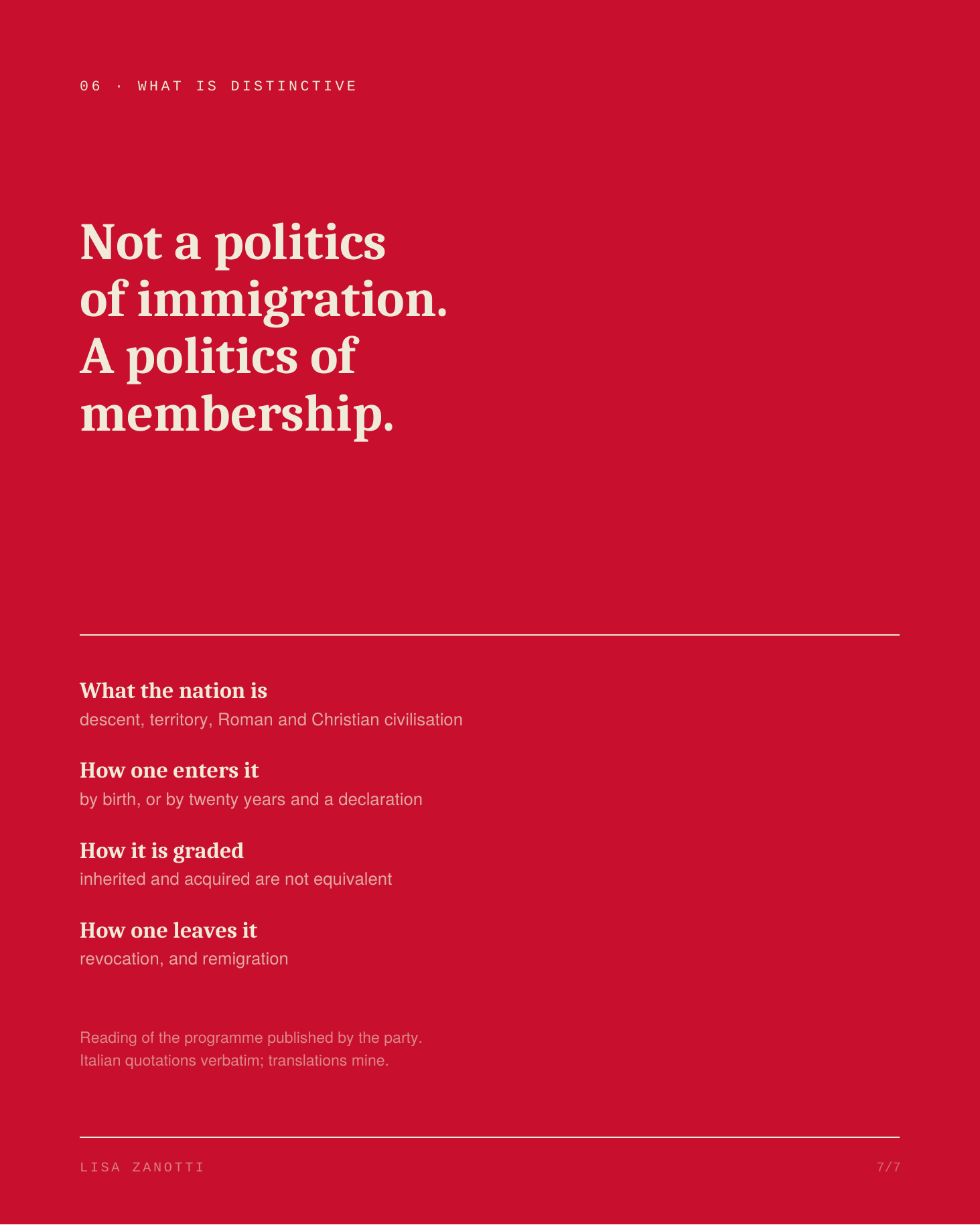
What is distinctive is not a politics of immigration but a politics of membership: what the nation is (descent, territory, Roman and Christian civilisation), how one enters it (by birth, or by twenty years and a declaration), how it is graded (inherited and acquired are not equivalent), and how one leaves it (revocation, and remigration).
Source: first programmatic document published by Futuro Nazionale (Italy, 2026). Italian quotations verbatim; translations mine.