Field Notes

Short analyses of political evidence as it appears: party programmes, speeches, interviews, survey data. Each piece works from a single source, or from a small set of comparable ones, reports it directly, and is published soon after the material becomes available.

Not research articles, and not commentary. Each note includes its figures and a downloadable PDF.

Field Notes are published first in The Reaction Post, in English and Spanish, and collected here. Subscribe →

  • Spanish
  • Chile and Argentina
  • Speeches

Same forum, two grammars of power

A comparative textual analysis of the opening and closing speeches at the 5th Regional Meeting of Foro Madrid.

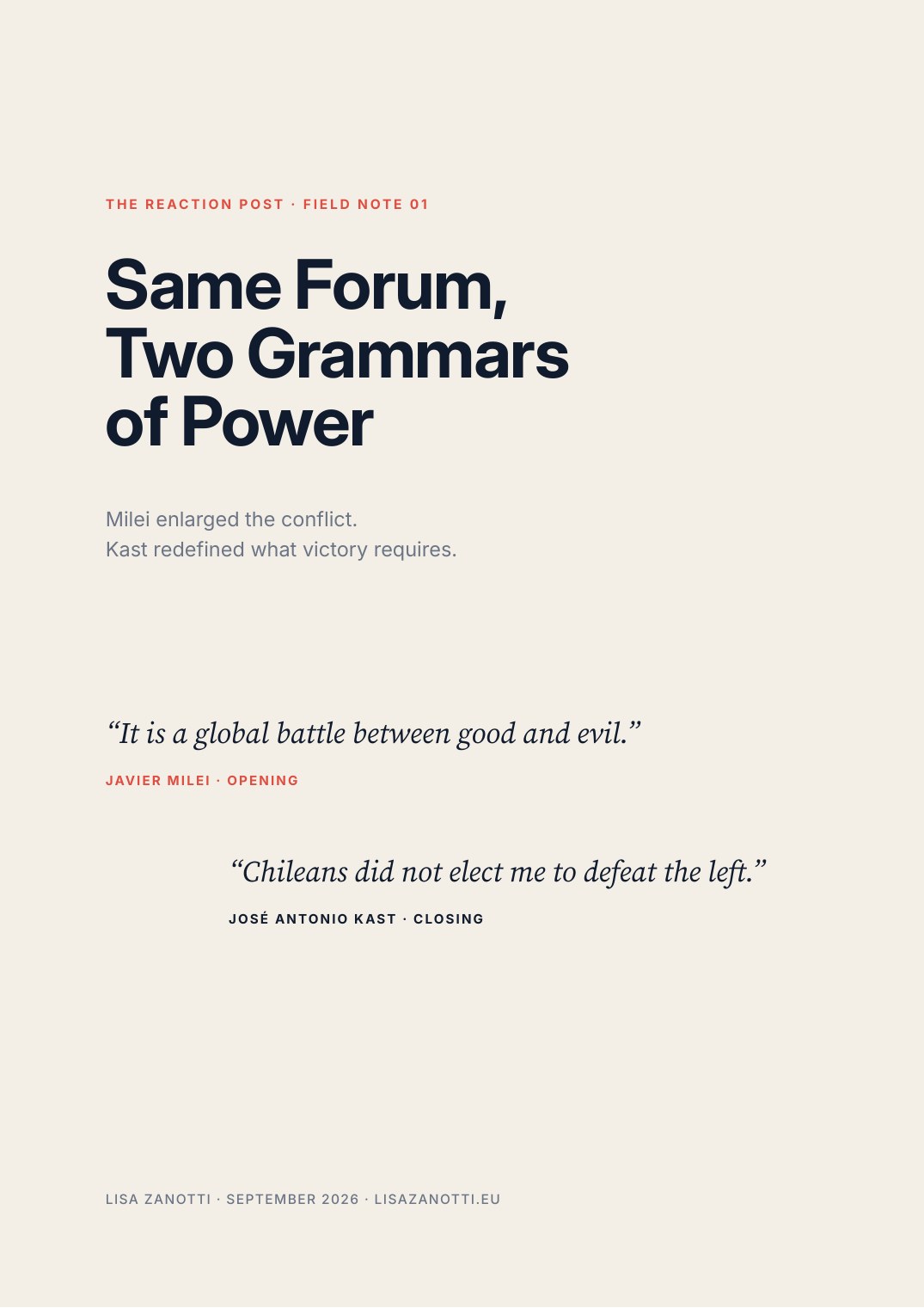
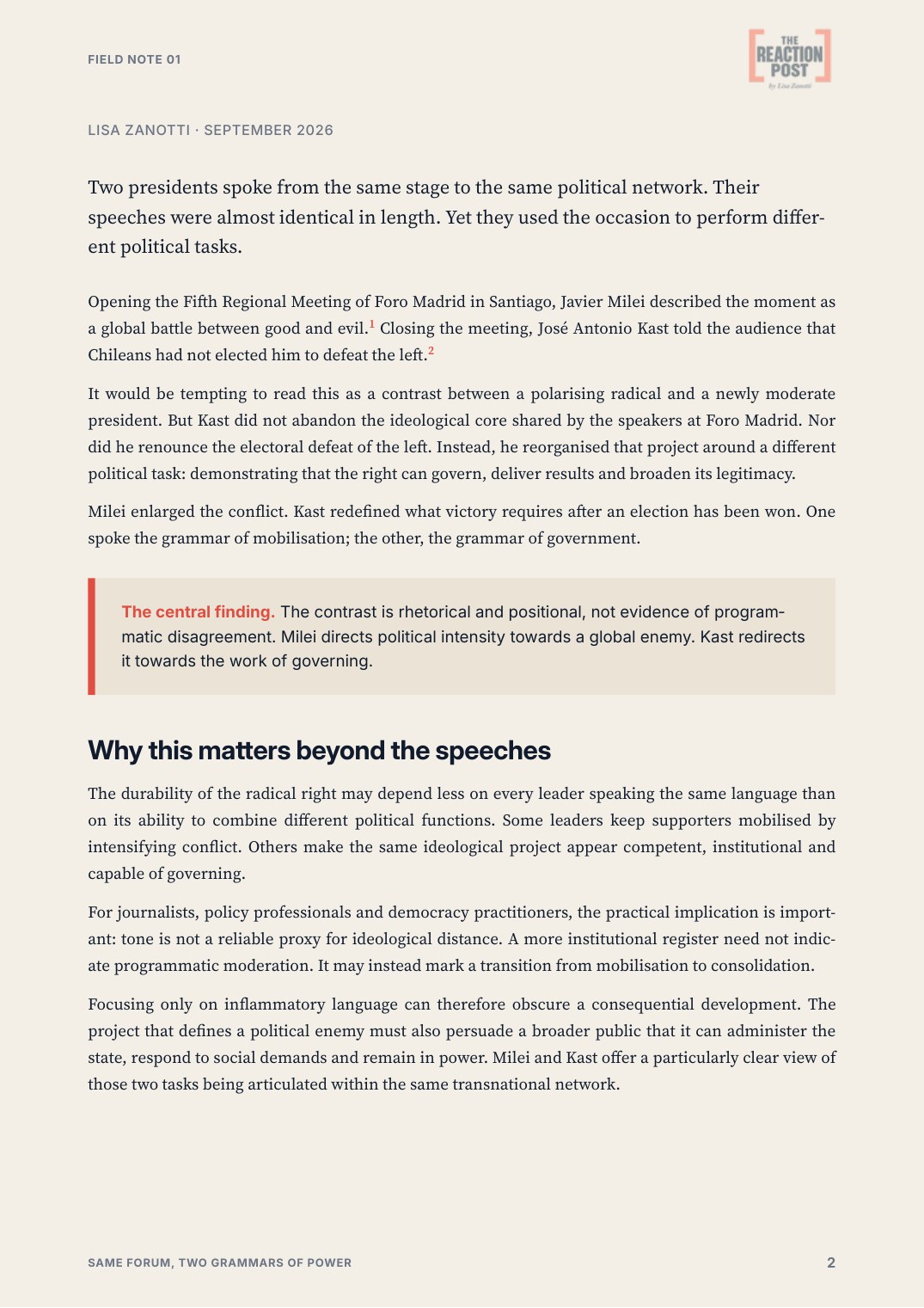
Javier Milei and José Antonio Kast spoke at the same event, before the same audience, and from a shared ideological base. Yet their speeches perform different political tasks. Milei places the conflict on a moral and global plane: «a battle between Good and Evil». Kast brings it back to government: «Chileans did not elect me to defeat the left».

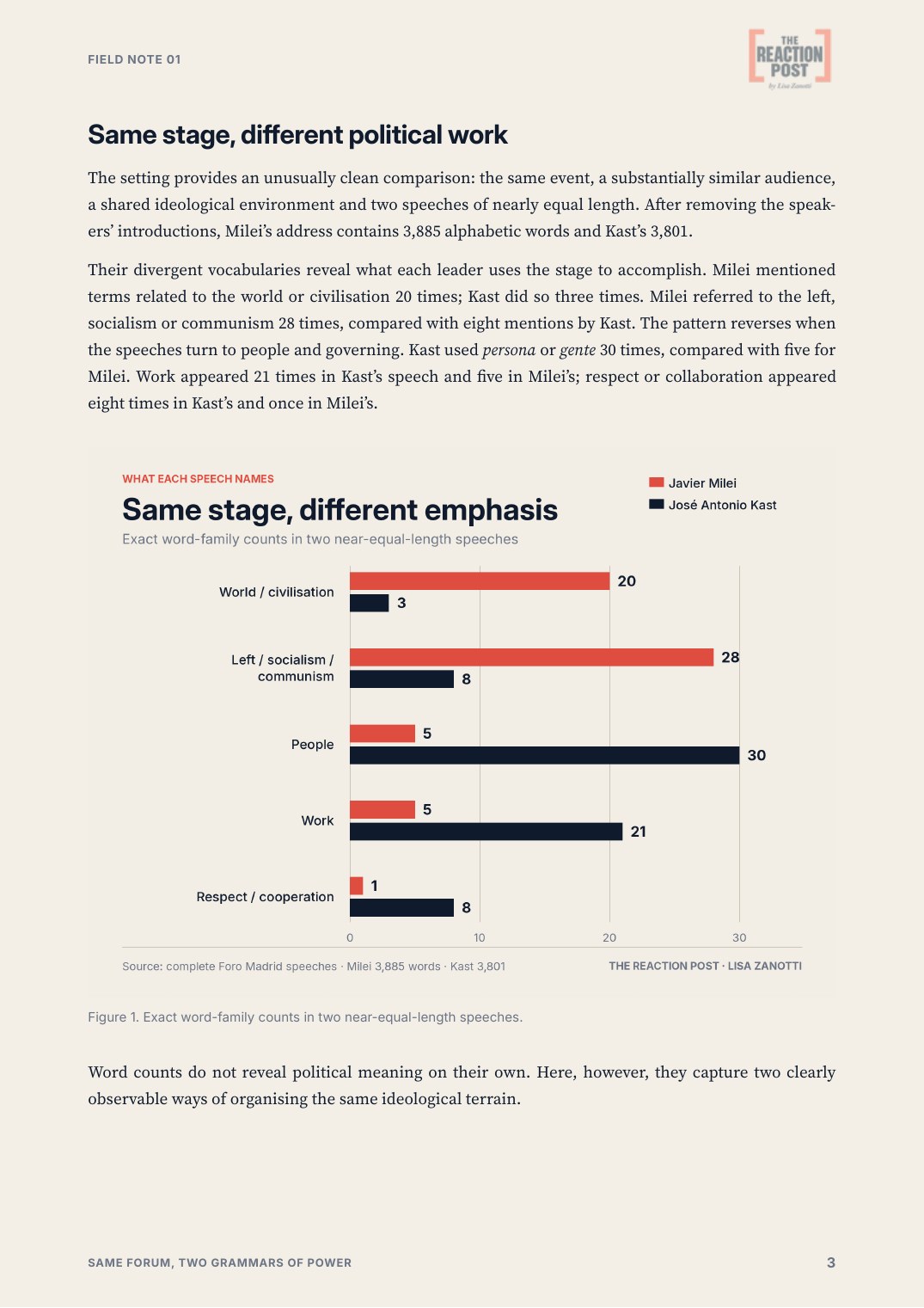
Their vocabularies barely overlap. Milei repeatedly names the world, civilisation, the left, and socialism. Kast speaks much more often about people, work, respect, and cooperation. One projects the dispute towards a global enemy; the other translates it into execution and results.

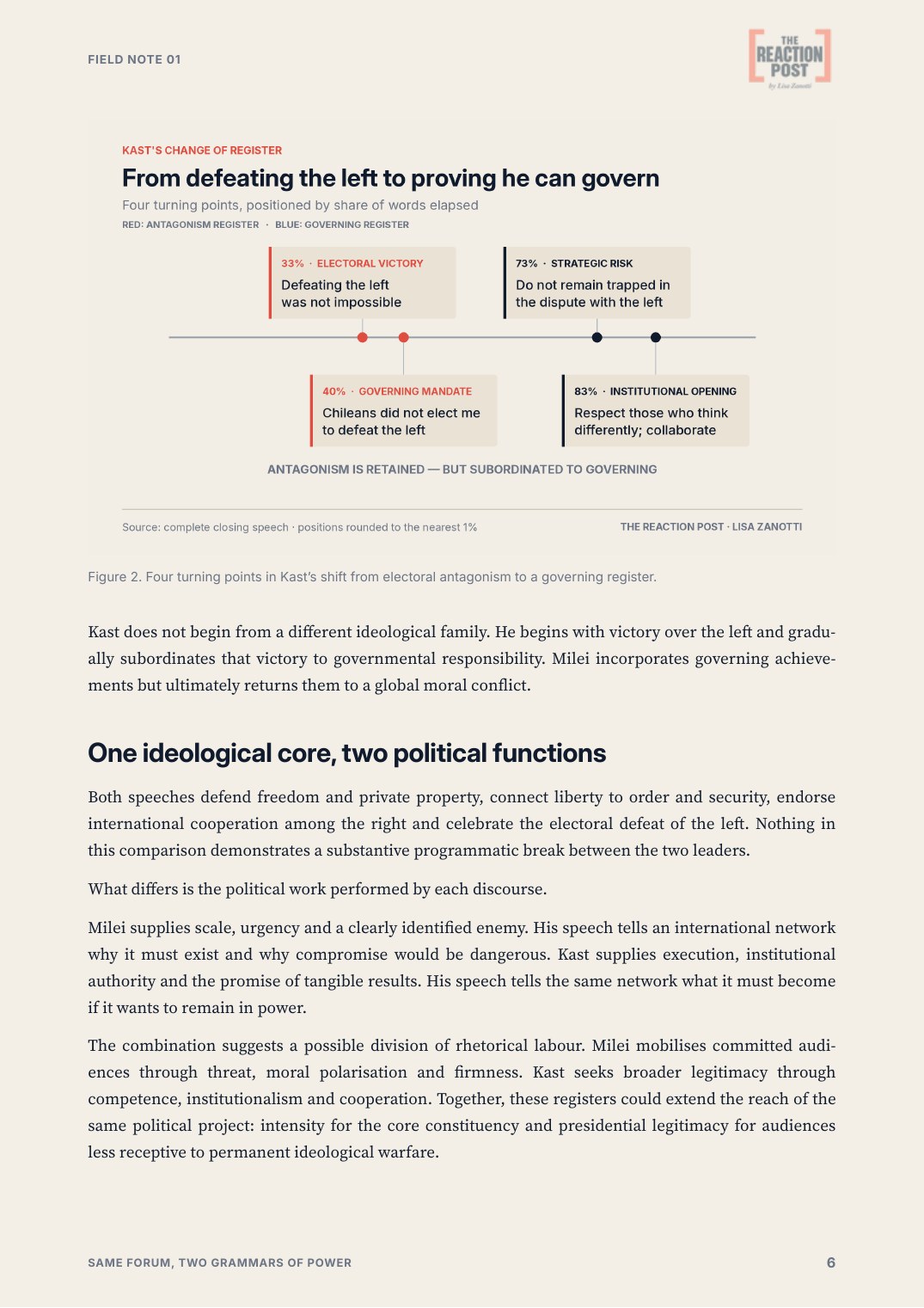
Kast also changes register within his own speech. He moves from electoral victory over the left to a mandate to govern, warns against remaining trapped in that dispute, and closes with institutional openness and respect for those who think differently. The antagonism remains, but it is subordinated to governing responsibility.

The shared core is intact: freedom and property, order and security, international coordination, and the electoral defeat of the left. The observed difference is rhetorical and positional, not evidence of programmatic disagreement.

The comparison suggests two functions within the same political project. Milei mobilises against someone through antagonism and moral scale. Kast mobilises towards something through execution, cooperation, and government. Neither lowers the intensity; each directs it differently.
Source: opening speech by Javier Milei and closing speech by José Antonio Kast at the 5th Regional Meeting of Foro Madrid, Santiago, 2026. Transcripts analysed directly.
  • Italian
  • Italy
  • Party programme

Futuro Nazionale: who counts as Italian, and for how long?

A reading of the first programmatic document of Italy's newest radical right party. Italian quotations verbatim; translations mine.

The programme of Italy's newest radical right party does not only say who should be kept out. It sets out what the nation is made of, how one may enter it, and how one may be removed from it.

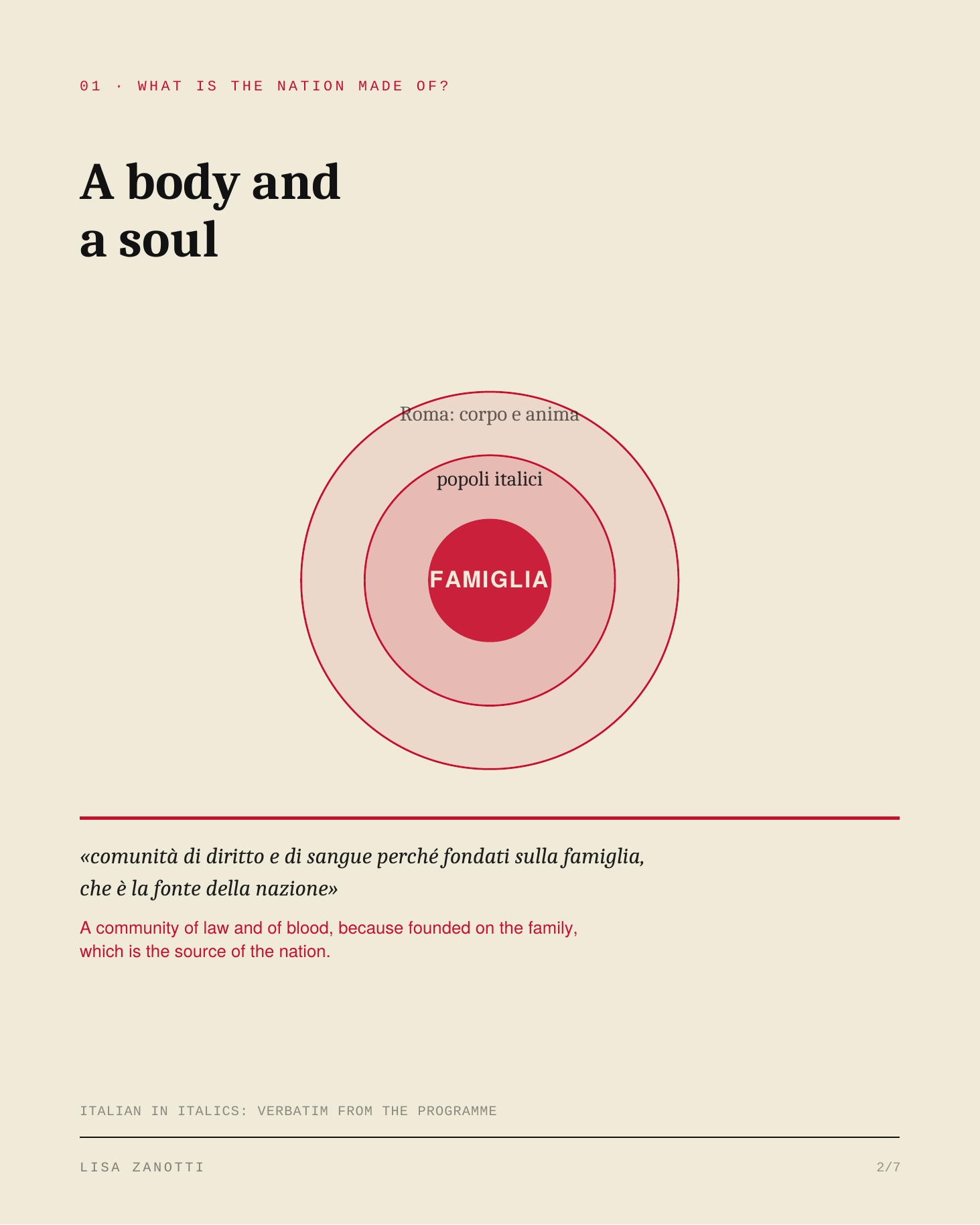
The nation is defined as a body and a soul: Rome as «corpo e anima», the popoli italici, and the family as its source — «comunità di diritto e di sangue perché fondati sulla famiglia, che è la fonte della nazione» (a community of law and of blood, because founded on the family, which is the source of the nation).

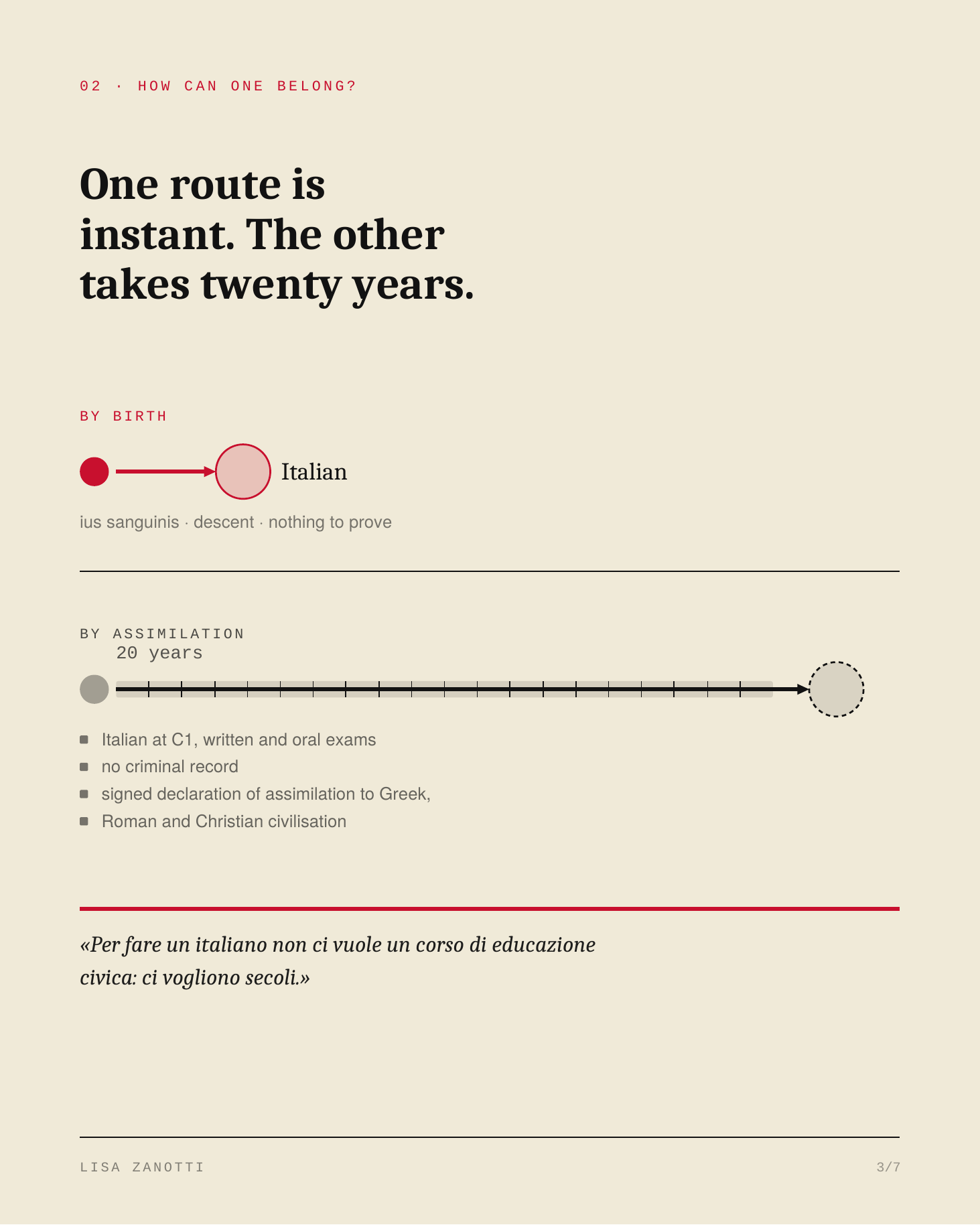
Two routes into membership are set out, and they are not equivalent. One is instant: ius sanguinis, descent, nothing to prove. The other takes twenty years and requires Italian at C1 with written and oral exams, a clean criminal record, and a signed declaration of assimilation to Greek, Roman and Christian civilisation. «Per fare un italiano non ci vuole un corso di educazione civica: ci vogliono secoli.»

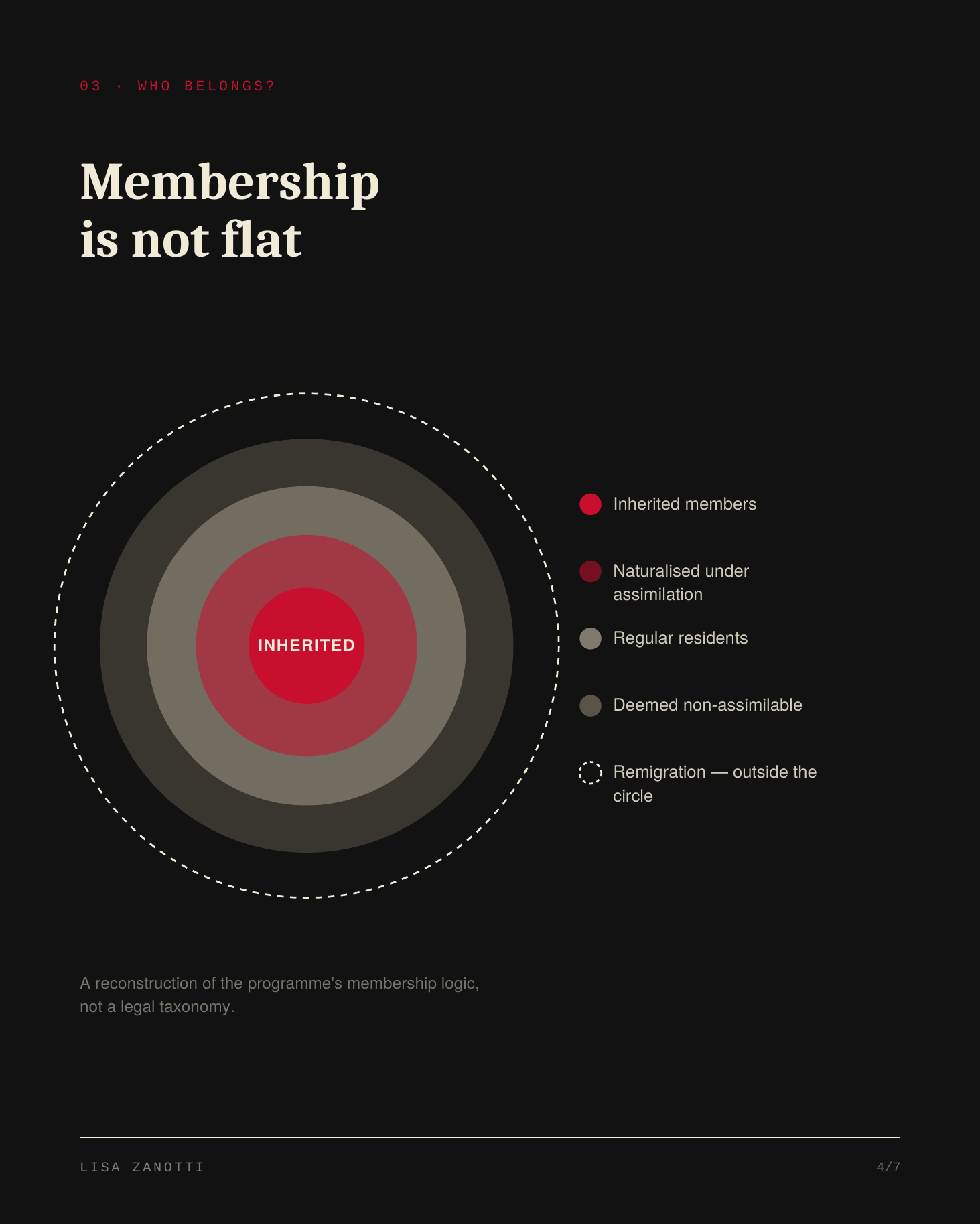
Membership, therefore, is not flat. Inherited members, those naturalised under assimilation, regular residents, those deemed non-assimilable, and those subject to remigration occupy different positions in relation to the national circle.

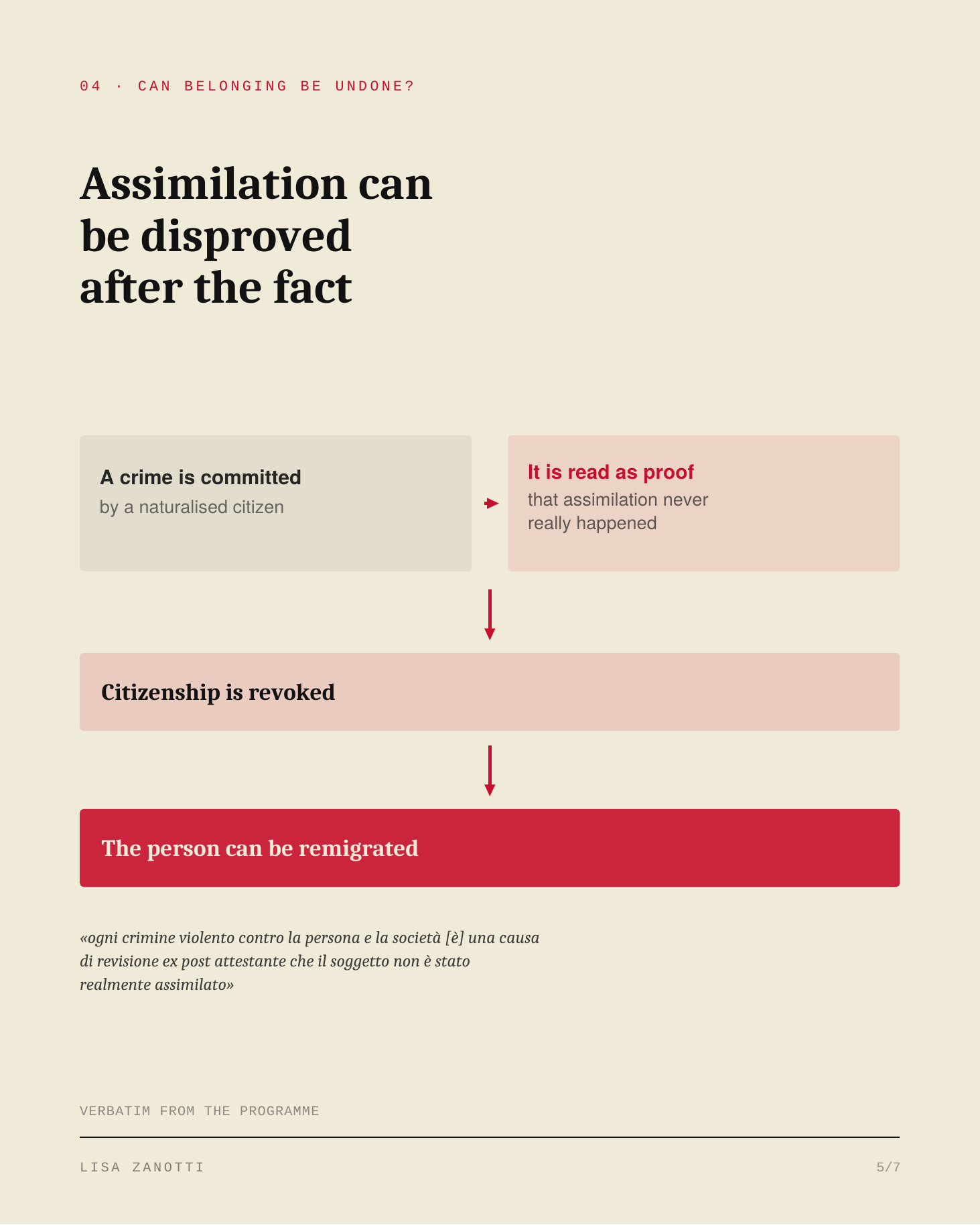
Belonging can also be undone. Assimilation may be disproved after the fact: a violent crime committed by a naturalised citizen is read as evidence that assimilation never really happened — «ogni crimine violento contro la persona e la società [è] una causa di revisione ex post attestante che il soggetto non è stato realmente assimilato» — and can lead to revocation of citizenship and to remigration.

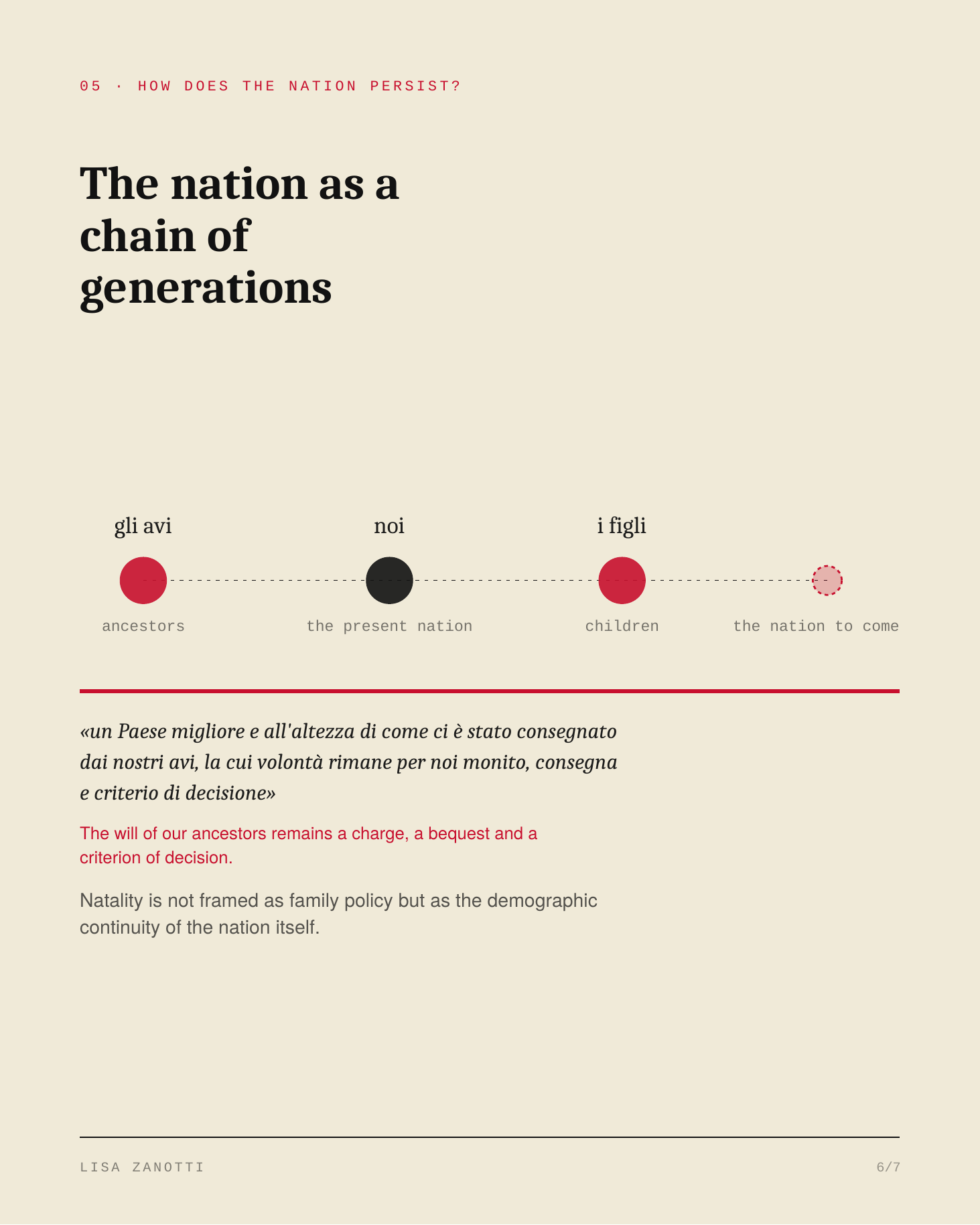
The nation persists as a chain of generations: gli avi, noi, i figli. «Un Paese migliore e all'altezza di come ci è stato consegnato dai nostri avi, la cui volontà rimane per noi monito, consegna e criterio di decisione.» Natality is not framed as family policy but as the demographic continuity of the nation itself.

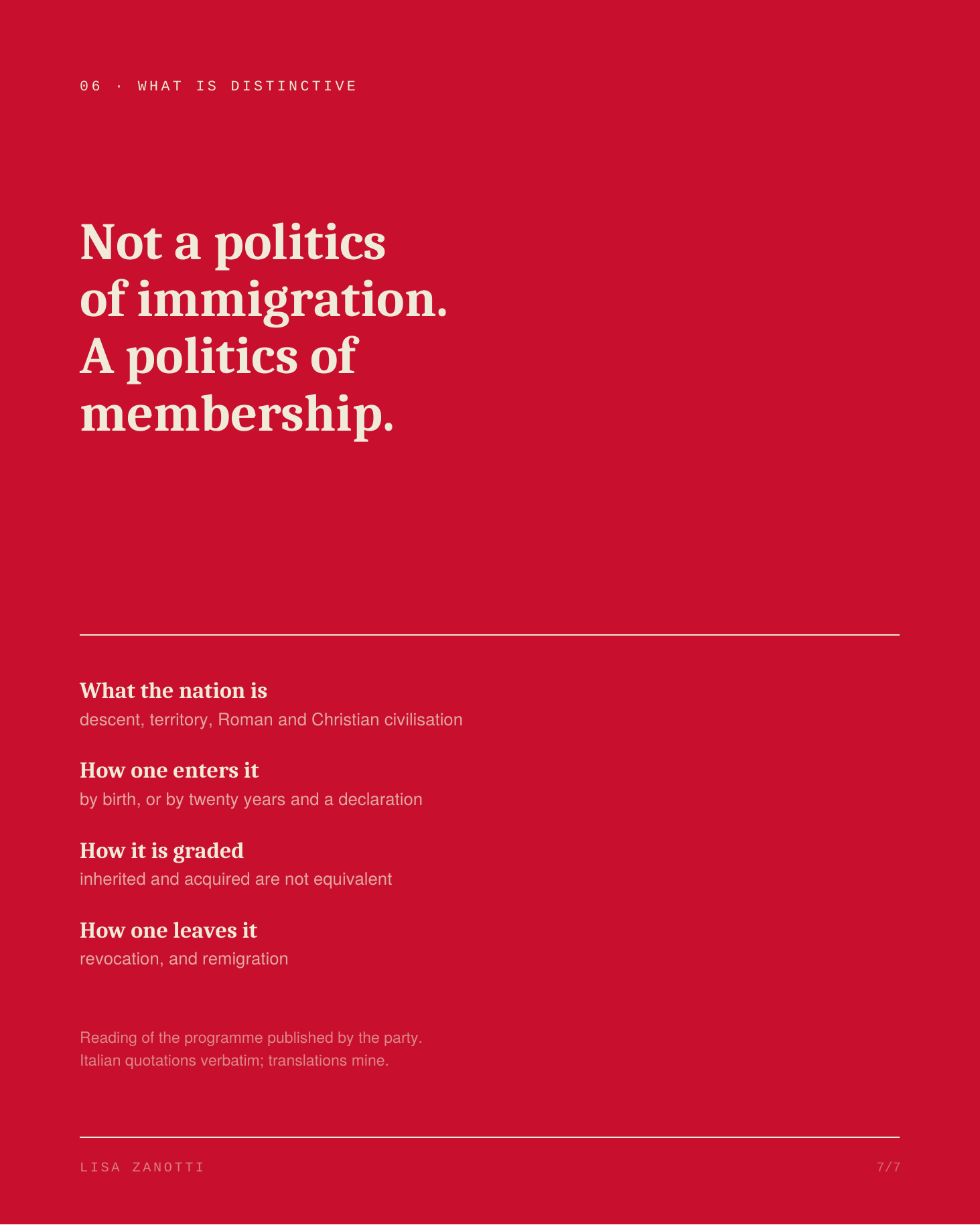
What is distinctive is not a politics of immigration but a politics of membership: what the nation is, how one enters it, how it is graded, and how one leaves it.

Source: first programmatic document published by Futuro Nazionale (Italy, 2026). Italian quotations verbatim; translations mine.